|
|
|
|
|
|
|
|
|
|
Member: |

|
|
|
|
|
|
|
|
|
|
|
|
| "The good man brings good things out of the good stored up in his heart, and the evil man brings evil things out of the evil stored up in his heart. For out of the overflow of his heart his mouth speaks." Jesus Christ |
|
|
 |
|
 |
|
|
|
|
|
|
|
|
|
Mala Accessories >> Counter
|
|
|
 |
|
Please contact us to verify availability. 1-626-354-6228
Email: zambalallc@gmail.com
America area customers can view on this website first.
https://FlyingMystics.org/ |
|
|
|
|
|
|
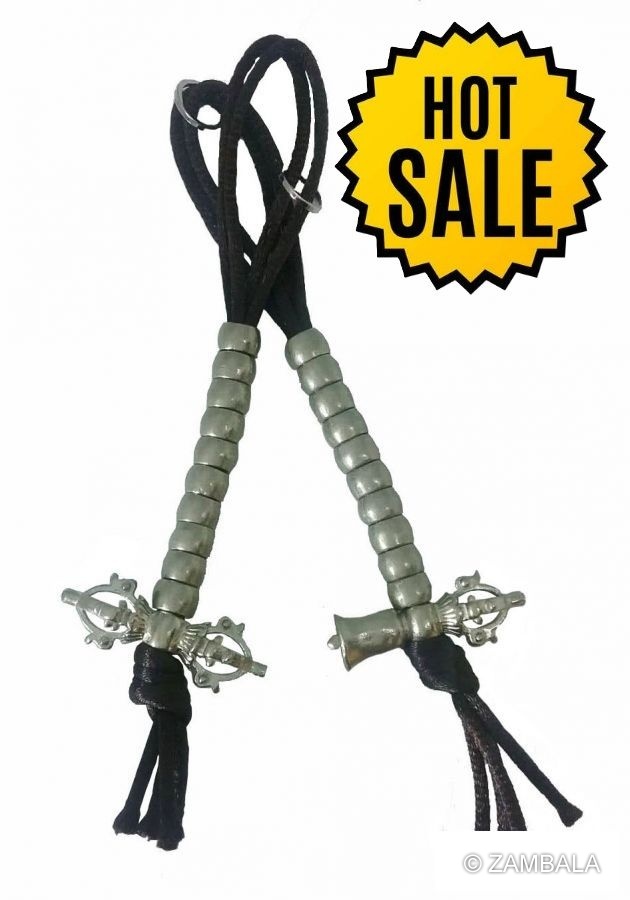
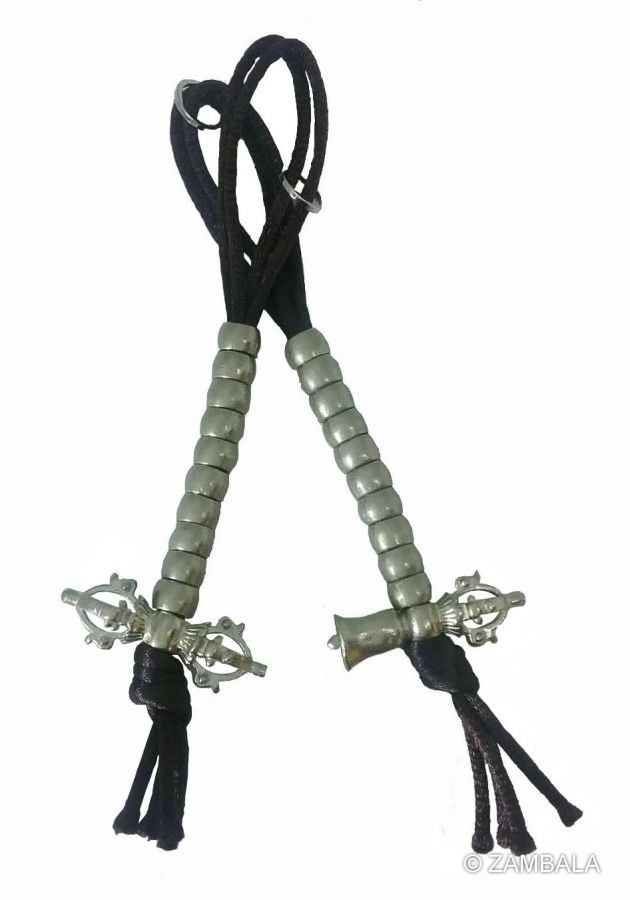
Material: Silver-plated white brass, binding cord, genuine leather cord body
Size: Two beads per set, approximately 10 cm in length
Description:
Introduction to the "counter" on Tibetan Buddhist prayer beads
In Tibetan Buddhism (Vajrayana), prayer beads (called "phreng ba" in Tibetan, meaning rosary or mala) are important tools for practitioners to recite mantras, chant Buddha's name, or accumulate merit. They typically have 108 main beads, symbolizing the eradication of 108 afflictions. To facilitate recording the number of mantra recitations (e.g., 100,000, 1,000,000), Tibetan prayer beads often come with a special **counter**, a distinctive accessory of Tibetan Buddhist prayer beads, different from the counting devices used in Han Chinese Buddhism.
Origin and History
- The origin of prayer beads can be traced back to ancient Indian Buddhism, around the 8th century BCE, used for counting mantra recitations. Tibetan Buddhist prayer beads evolved after Buddhism was introduced to Tibet, incorporating characteristics of Vajrayana (Tantric) practice.
- The emergence of counters primarily stems from the Vajrayana tradition's emphasis on "accumulated practice" (such as reciting a specific deity's mantra over a million times). Practitioners need to precisely record the number of repetitions to fulfill specific empowerments or retreat commitments.
- Counters are typically decorated at the end with a **vajra (dorje/vajra)** and a **bell (bell/dril-bu)**, these two implements being core symbols of Vajrayana: the vajra represents "skillful means" (compassion and indestructibility), and the bell represents "wisdom and emptiness." Their design originates from thunder weapons in ancient Indian mythology, later transformed by Buddhism into implements symbolizing the inseparable nature of wisdom and compassion.
- This bell-and-vajra counter form gradually became widespread in Tibet, becoming a standard accessory to Tibetan prayer beads, especially in the Nyingma, Kagyu, Sakya, and Gelug schools. Early counters may have used simple knots or wooden beads, later evolving into more elaborate counters made of metal (silver, copper).
Instructions for Use: Tibetan prayer beads typically come in pairs (two strings), each with 10 small beads (counters), and a small vajra and bell attached to the end. They are usually attached to the 21st or 27th bead on either side of the guru bead (traditionally secured with a small ring, not directly tied to the main line, as a sign of respect).
- **Basic Counting Principles:**
- One round of the main beads (108 beads) is usually counted as 100 repetitions (the remaining 8 repetitions are used for filling gaps or offerings).
- After completing one round of the main beads, move one small bead to the "hundreds counter" (usually the vajra end, representing the hundreds place).
- When all 10 beads on the vajra counter have been moved (i.e., 10 rounds, representing 1000 repetitions), move one small bead to the "thousands counter" (the bell end).
- At the same time, reset the counter on the vajra end to zero.
- **Advanced Counting:**
- Many prayer beads also have "clips" (bum counters or clips) for counting the ten-thousands place. When the counter has been turned 10 times (i.e., 10,000 repetitions), move the clasp past one of the main beads.
- Some older rosaries use different colored knots (Vajra knots) to mark higher positions (such as the millionth).
- **How to Hold the Beads:** When reciting the mantra, start beside the Buddha head and turn the beads clockwise. When you reach the Buddha head, flip the beads and continue (without passing the Buddha head, to show respect to the guru). The counter is only used to record the number of repetitions and does not participate in the main mantra movement.
**Impact and Significance on Buddhism:**
**Practical Impact:** The counter allows practitioners to accurately complete a large amount of accumulating practice (such as reciting the Avalokiteshvara mantra "Om Mani Padme Hum" one million times), which is key to attaining enlightenment in Vajrayana. Without a counter, recording one million repetitions is extremely difficult and prone to laziness or errors.
- **Symbolic Impact:**
The vajra and bell represent the inseparability of wisdom (emptiness) and compassion (skillful means), reminding practitioners of the "perfect harmony of the two truths" (the unity of relative and absolute truth). - The counting itself symbolizes diligence and commitment (samaya), reinforcing the practitioner's vows.
- In Tantric rituals, the bell and vajra are also used for blessing and purification; the counter extends this symbolism, making everyday prayer beads a miniature ritual.
- **Cultural Influence**: The counter adds decorative and religious depth to Tibetan prayer beads, becoming a symbol of Tibetan culture and influencing the modern antique market. But essentially, it is a ritual implement, reminding practitioners of "unwavering diligence," and has made a profound contribution to the Tibetan Buddhist traditions of retreat and initiation.
In short, the counter is not only a practical tool but also a symbol of the unity of wisdom and compassion in Tibetan Buddhism, helping countless practitioners achieve profound accumulation of merit. If you are a practitioner, it is recommended to use it under the guidance of a guru to obtain the greatest benefit.
|
|
|
 |
|
|
|
|
|
© 2026 Zambala inc. All Rights Reserved. No part of this site may be reproduced without our written Permission.
Service Mail: ZambalaLLC@gmail.com
Phone: (626) 289-9787 or 1(888)Zambala (926-2252)
Fax: (626) 289-9719
1904 West Valley Blvd. Alahambra, CA 91803 USA
Unless stated otherwise in content's license. Design By
|
|
|